
Rolex vs. Tudor: Which One Is Actually Worth Your Money?
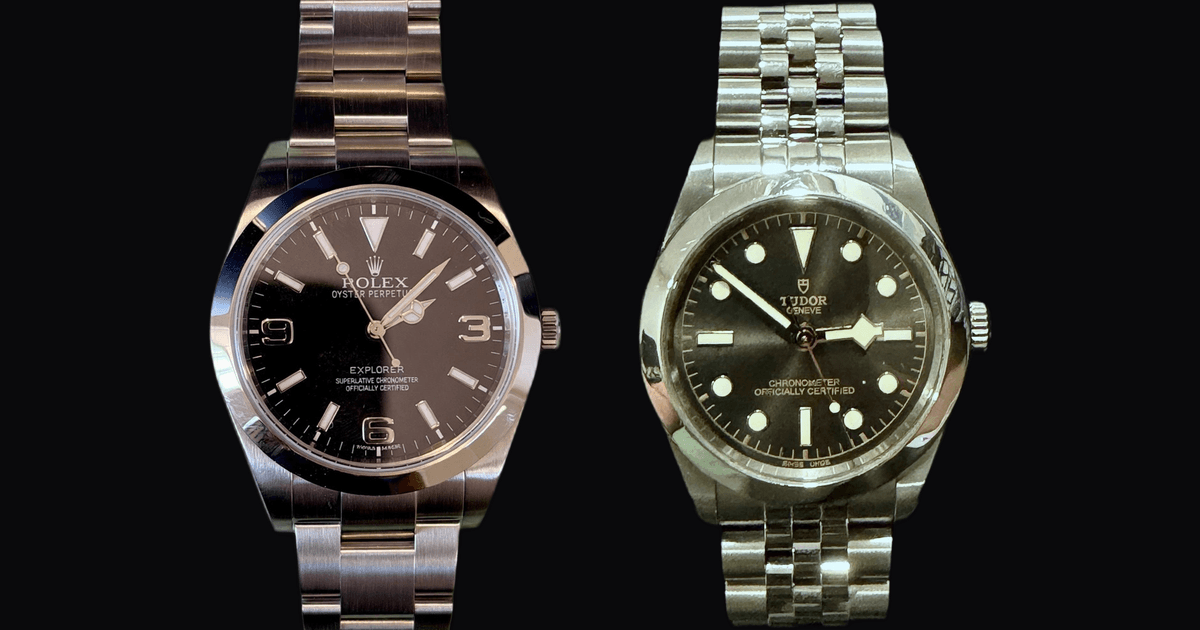
Rolex or Tudor? Same family, different price tags. Here's what you're actually paying for — and how to decide which one belongs on your wrist.
At some point, almost everyone shopping for their first serious watch runs into the same dilemma: Rolex or Tudor? One has the crown, the recognition, and a price tag that might require a conversation with your significant other. The other has serious watchmaking credentials, a considerably friendlier price, and absolutely no reason to apologize for either. So what's the difference? And more importantly, is the Rolex actually worth the extra money? Well, that depends on what you're buying it for.
They're family. That doesn't make them the same watch.
First, the part everyone gets wrong: Tudor is not a Rolex knockoff, and Rolex didn't buy it to compete with itself. Tudor was created by the same man who founded Rolex — Hans Wilsdorf registered the Tudor name in 1926 and founded Montres Tudor SA in 1946 — with a stated aim that still explains the brand: a watch a dealer could sell for less than a Rolex, yet still meet Rolex's standard of dependability.
For decades that meant Tudor watches built around Rolex cases and bracelets, with bought-in movements to keep the price down. Both are still owned by the Hans Wilsdorf Foundation, but they run separately, and Tudor has spent the last decade building an identity of its own.
So no, buying a Tudor is not buying a fake Rolex or a lesser Rolex. It's buying the other company Wilsdorf built, on purpose, for a different price.
So why does one cost more?
Because some of the gap is the watch, and some of it is everything around the watch.
Rolex uses 904L stainless steel, marketed as Oystersteel, in its modern steel watches. Tudor generally uses 316L, which is also widely used throughout the luxury watch industry. Rolex's alloy offers greater corrosion resistance, but for most people wearing a watch in everyday life, the difference is unlikely to be noticeable. It's a technical distinction, not necessarily a practical advantage.
Then there's testing, and here the dates matter. A Tudor manufacture movement that carries COSC certification is tested as an uncased movement to −4/+6 seconds per day — but not every Tudor caliber carries COSC certification, so that claim belongs to specific calibers and models, not to the brand as a whole. Rolex's modern standard goes further: it tests the finished, cased watch to its Superlative Chronometer standard of −2/+2 seconds per day, under a testing protocol established in 2015. That date matters because it means the −2/+2 standard should not be presented as the original certification standard for older watches — our 2008 Submariner and 2013 Explorer below predate it.
And one distinction that gets lost in spec-sheet comparisons: a tighter certification standard does not mean a Tudor is necessarily less accurate on your wrist. Certification describes tested tolerances under test conditions, not a guaranteed difference in actual everyday performance. A well-regulated watch from either brand can run beautifully; the certificate tells you what it was tested to, not what it will do on your wrist next Tuesday.
Then there's everything around the watch: demand, allocation, and the crown. Certain Rolex references are hard to get new, and that scarcity spills into pre-owned. Tudor is generally available near its intended price. And the Rolex name itself is legitimately part of the appeal — recognition and demand are real parts of what the premium buys, and there's nothing wrong with valuing them.
None of that makes the Tudor a compromise. It makes the two brands different answers to different budgets.
Movements: the gap closed more than people think
This is where old advice about Tudor goes stale: the idea that Tudor means "someone else's movement" is twenty years out of date for most of the range.
Tudor introduced its first manufacture movements in 2015 and has since expanded its use of movements developed and produced through Kenissi. The Black Bay 39 runs the manufacture caliber MT5602 — COSC-certified, about 70 hours of reserve. Set it down Friday evening, pick it up Monday morning still running.Not every Tudor has an in-house movement, and that's worth knowing. The 1926 runs caliber T601, based on the widely used ETA 2824-2 architecture (or its Sellita equivalent), with about 38 hours of reserve — a proven workhorse that nearly any competent watchmaker can service, because the architecture is so common.
So the movement story isn't "Rolex good, Tudor cheap." Some Tudor models, like the Black Bay 39, offer manufacture movements with impressive power reserves. Others, like the 1926, use proven movements that have been around long enough for watchmakers to know them inside and out. Rolex runs its own calibers to a tighter finished-watch standard on its modern watches. All three are good answers at different prices.
What you actually notice on the wrist
Here's where the comparison gets concrete — and where it helps to compare the right watches. Our Black Bay 39 and our Explorer 214270 are the natural pairing: understated, steel, everyday sports watches with relatively simple designs. Neither shouts. That's exactly why the comparison is useful.The Black Bay 39 is a 39mm steel watch with a smooth, fixed steel bezel and a clean black dial. It is not a dive watch — there is no rotating dive bezel, no dive scale, no diver's pretension. It's an everyday sports watch, honest about what it is. The Explorer is the same idea from the other side of the family: a 39mm steel Rolex with a simple black dial, built to be worn hard and noticed little. Put them side by side and the question stops being about brand and starts being about which one you'd reach for in the morning. Side by side, some buyers notice a difference in the small places — the way a clasp clicks, how a case edge catches light. But that's perception, not a measurement, and it varies watch to watch — especially when you're comparing pieces from different years, like a 2024 Tudor against a 2013 Rolex. Don't let anyone sell you a finishing gap as a fact; your eyes and your wrist are the only judges that matter here. If you can, try both on. The wrist decides faster than the internet does.
One practical note: ask what's included in the bracelet and whether it will fit your wrist without adjustment — the same question from our first-Rolex piece.
The resale question, answered honestly
The uncomfortable part, plainly: in the pre-owned market, Rolex references generally hold value more strongly than Tudor references. Demand is broader, recognition is instant, and that shows up at resale.
That statement needs its qualifiers, though. Resale depends on the specific reference, what you paid, the watch's condition, and market conditions at the time you sell — it is not a property of the brand name alone. A Tudor bought well can do fine; a Rolex bought badly can disappoint. And none of this makes a Rolex an investment. Buy the watch because you want to wear it — the same rule we laid out for first-time Rolex buyers. Anyone who guarantees a watch will appreciate is selling you something other than a watch. But if resale is a major part of your decision, know the crown tends to carry a premium on the way out, not just on the way in. If resale barely matters, Tudor's case gets a lot harder to argue against.
Four watches that show the range
Here are four watches we've had through The Watch Vault that illustrate just how different the options can be.
These are examples, not a live availability list — prices are examples recorded on October 30, 2026, and some of these pieces may have sold since:
- Tudor 1926, 41mm, full set — $2,200 (recorded October 30, 2026). Steel case and bracelet with rose-gold hands and numerals on a silver embossed dial. (Note: that's rose-gold detailing, not a two-tone case and bracelet.) A dress watch at a price that makes a first serious purchase feel sane.
- Tudor Black Bay 39, 2024, black dial, full set — $3,200 (recorded October 30, 2026). The in-house MT5602, 70-hour reserve, 39mm case, smooth fixed steel bezel. The sport-watch argument for Tudor in one watch.
- Rolex Explorer 214270, 2013, papers only — $7,800 (recorded October 30, 2026). Papers only, no box — the cleanest, most understated Rolex in the range, for buyers who want the crown without the flash.
- Rolex Submariner 16613LN, 2008, full set, black dial and bezel — $11,500 (recorded October 30, 2026). Two-tone steel and gold — the watch that makes the Rolex premium most visible.
The gap between the Black Bay example and the Explorer example is real money — and what it buys is what this article describes.
How to decide
If you're choosing between the two, ask yourself these in order:- What can I spend without flinching? If the Rolex number makes you nervous, remember: The Tudor isn't a consolation prize — it's the right watch at the right price.
- How much does the name matter to you? If recognition, resale, and the feeling of having arrived matter — and that's a legitimate part of a purchase, not something to apologize for — buy the Rolex and enjoy it without apology.
- What will I actually wear every day? A Tudor you wear daily beats a Rolex you baby in a drawer.
- Does the movement matter, or just the result? If in-house calibers and long reserves excite you, the Black Bay delivers. If you just want it to run and be easy to service, the 1926 is the simpler life.
- What are the return and warranty terms? Know them before you buy, regardless of the brand or price. At The Watch Vault, we offer a three-business-day inspection period and a 30-day mechanical warranty, subject to our published terms. You can read the details on our Returns page.
A note on authenticity
Whichever brand you choose, the authenticity question is the same — ask it out loud. No single serial-number check, document, or photograph establishes authenticity on its own. We verify serial numbers on every watch where they're accessible without opening the case. When a watch comes with serial-numbered documentation, we check that the numbers match. If a seller gets vague when you ask, walk away — whether the watch says Rolex or Tudor.
The short version
Tudor is not Rolex's discount bin. It's the company Rolex's own founder built to deliver Rolex dependability at a lower price, and today it builds serious in-house movements and honest everyday watches. Rolex charges more because its materials and testing are a step beyond in the specs — and because the crown carries real value in the market.
Buy the Rolex if the name matters to you and the number doesn't scare you. Buy the Tudor if the watch matters more than the name, or if you'd rather keep the money. Either way, buy the watch you'll actually wear, from a dealer who answers your questions without making you feel small for asking.
There's no wrong answer here. Just the watch that's right for you.