
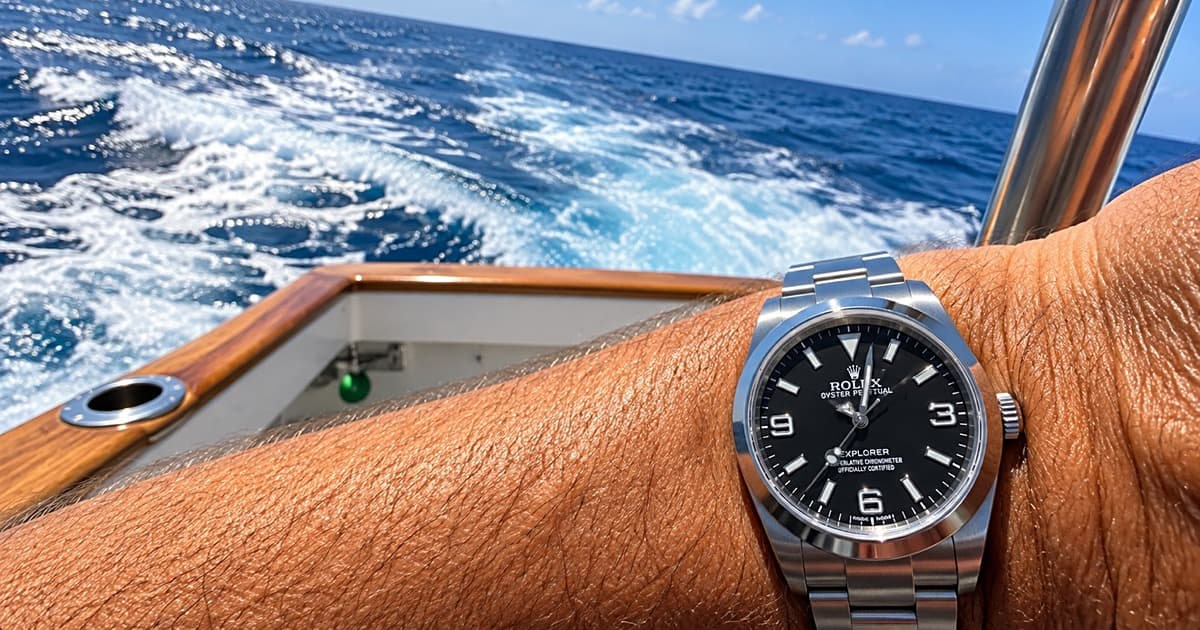
Buying your first Rolex? What to ask a pre-owned dealer before you pay, from reference numbers and box and papers to authenticity, condition and returns.
There's a question almost every first-time Rolex buyer is really asking, and it's almost never the one they say out loud.
They ask, "Which Rolex should I buy?"
What they mean is: "Am I about to spend thousands of dollars on something I don't actually understand?"
That's not an embarrassing question. That's the smart one. And if you're asking it, you're already doing this better than most people do.
Nobody expects you to know this already
Here's something dealers won't always say: the watch world runs on jargon, and a lot of it exists to make newcomers feel like outsiders. Reference numbers, calibers, "full set," "unpolished," "service history" — it's a lot of vocabulary to absorb before you've spent a dollar.
A good dealer will explain any of it without making you feel small for asking. If a seller ever makes you feel dumb for asking a basic question, they've told you something important about themselves. Believe them, and buy somewhere else.
Every question in this article is one you're allowed to ask. Every single one.
New vs. pre-owned: the honest trade
Buying new from an authorized dealer is a particular experience: a brand-new watch, the manufacturer's warranty, and, for certain highly sought-after models, potentially a wait. Sometimes a long one. Allocation is real, and "just walk in and buy one" is not how the desirable references usually work.
Buying pre-owned is a different trade. You can usually get the exact reference you want, sometimes for less than the new price — or, for discontinued pieces, at all. What you give up is the new-watch certainty. Condition varies. History varies. The homework is on you, or on the dealer you trust to do it.
Neither path is the "right" one. They just answer different questions. If what you want is a specific watch on your wrist soon, pre-owned is usually how that happens.
The reference number is the whole game
Every Rolex has a reference number, and learning it is one of the smartest things a first-time buyer can do. A short code identifies the model, and often the material and bezel. A Submariner 16610 is not a Submariner 126610. They look like cousins. They are not the same watch, and they are not the same price.
Before you fall in love with a watch, learn its reference number. It is one of the most useful things you can know, because it lets you compare like with like. Two listings for the "same" watch at wildly different prices usually turn out to be different references, different years, different condition, or different levels of completeness. And even two listings with identical references can still differ substantially in price — condition, originality, production variations, and service history can be equally consequential. Occasionally, one of them is just a better deal. Usually, there's a reason.
If a listing doesn't state the reference number clearly, ask for it. That's not being difficult. That's the bare minimum.
Box and papers: what they actually mean
You'll hear "full set" a lot. Generally, it means the watch comes with its original box and warranty papers or card, although exactly what's included can vary by seller and production year. Always ask for an itemized description of what's included. A watch with papers but no box is a different tier. A watch with neither is "naked."
Here's what nobody tells you: the box and papers are worth something, but they don't turn a bad watch into a good one. A complete set on a tired, over-polished watch is still a tired, over-polished watch. And a beautiful, honest watch without its box is still a beautiful, honest watch.
We wrote a whole piece on this, because it's the question that confuses first-time buyers more than any other: Full Set vs. Naked: What the Box and Papers Are Actually Worth. Read it before you pay a premium for a box.
"Is it real?" — the question everyone is afraid to ask
This is the one people whisper. Say it out loud instead. It's the most reasonable question in the entire hobby.
A reputable dealer should be able to tell you, plainly, how authenticity was established.
No single serial-number check, document, or photograph establishes authenticity on its own.
Our standard, stated plainly: we verify serial numbers on every watch where they're accessible without opening the case. When a watch comes with serial-numbered documentation, we check that the numbers match.
If a seller gets vague when you ask about authenticity, or treats the question as an insult, walk away. A real dealer has heard the question a thousand times and will answer it a thousand and first.
Condition: scratches are information
A pre-owned watch has lived a life, and the scratches are the record of it. Light surface wear on a bracelet is normal. It's what a watch looks like when someone actually wore it and enjoyed it.
What you want to understand is the difference between honest wear and a hard life: deep gouges, a case that's been polished so many times its edges have gone soft, a dial that's been refinished. A good listing photographs the flaws instead of hiding them, and a good dealer tells you about them before you ask.
Polishing can make a worn watch look newer, but it also removes material. We prefer to leave our watches in honest, unpolished condition so buyers can see the watch as it actually exists, rather than wonder what refinishing might have concealed. (We'll get properly into polishing in a later piece — it's a subject that deserves its own article.)
Price: why the same watch costs different amounts in different places
This is the part that drives first-time buyers crazy, and understandably so. You find three prices for what looks like the same watch, and they disagree by hundreds or thousands of dollars.
Usually, the difference is real: condition, completeness, year, bracelet, service history, and what the seller had to spend to stand behind it. A watch with a fresh service, a full set, and a dealer who'll take it back if something's wrong may command a higher price than the same reference from someone who won't. That's not a markup mystery. That's the price of the safety net.
Two warnings, both worth memorizing. First, a price far below every comparable listing is not a bargain you discovered. It's a question you haven't answered yet. Second, a watch is not an investment strategy. Buy the watch because you want to wear it. Anyone who guarantees it will appreciate is selling you something other than a watch.
Before you pay: the checklist
Ask these before money moves, not after:
- What's the exact reference number, and does it match the watch in the photos?
- What comes with it — full set, papers only, or naked — and is that reflected in the price?
- How was authenticity established, and what's the recourse if an independent check disagrees?
- What's the service history, and is there documentation for it?
- What's the inspection and return policy? (Ours, for reference: a 3-business-day inspection return, subject to the conditions on our Returns page, and a 30-day mechanical warranty.)
- What's included in the bracelet, and will it fit your wrist without adjustment?
- What payment methods are accepted, and what does each one cost you?
If a seller answers all of that patiently, you're in good hands. If they rush you past it, you're not.
After it arrives
When the watch arrives, inspect it promptly and carefully. Compare its condition, reference, included accessories, and documentation against the listing. Follow the seller's inspection requirements, and raise any concerns before the return window expires.
And if you want a second opinion from an independent authenticator for your own peace of mind, that's a reasonable thing to do, not an insult to the dealer. Any dealer worth buying from will understand that. If your return window is still open, coordinate any case opening with the seller first, since a watch that's been opened or worked on may no longer be returnable.
The short version
You don't need to know everything about Rolex to buy your first one. You need to know the reference number, what "full set" actually means, how authenticity was established, what condition you're really looking at, and what happens if something's wrong.
Ask the questions you're embarrassed to ask. They're the questions that protect you. And the dealer who welcomes them is the dealer you should buy from — whether that's us or someone else.
That's the whole secret. There's no handshake, no code word, no test you have to pass. Just a buyer who did the homework and a dealer who respects that.