
Spend enough time shopping for a pre-owned luxury watch and you'll eventually encounter two terms that sound considerably more dramatic than they actually are: "full set" and "naked." Relax. We're still talking about watches.
Here's what those terms mean, what the extras are actually worth, and when they're worth paying for.
First, "full set" isn't a universal definition
This is the part that trips people up. There's no governing body that certifies what counts as a full set. One dealer's "full set" might include the original purchase receipt; another's might not. One might count spare links, another might not.
So the first rule is simple: if the extras matter to you, ask exactly what's included before you pay. A good dealer will list it piece by piece. If they won't, that's your answer.
The three tiers, honestly labeled
In practice, pre-owned watches tend to fall into three buckets:
Watch only (naked). Just the watch. No box, no papers. This doesn't mean the watch is fake, damaged, or lesser. It means the extras got lost somewhere along the way. Boxes get thrown out during moves. Papers live in a drawer nobody can find anymore. Nobody's judging you for losing a box — historically, it's the first thing to go.
Watch with papers. The watch plus its warranty card and papers, maybe booklets, but no box. This is a real middle tier, and it deserves its own name — because it's not naked, and it shouldn't be priced or described as if it were.
Full set. Generally, the watch, original box, warranty card or papers, and whatever original accessories are included. Depending on the watch and the seller, that might mean booklets, hang tags, spare links, or other goodies. The important part isn't the label. It's knowing exactly what's included.
Why the extras are worth money
Three reasons, roughly in order:
1. They support the watch's story. Original papers tie a watch to its origin, and that provenance is genuinely useful. But let's be precise: papers support provenance. They don't independently authenticate a watch. Authentication is a separate process entirely. It involves examining the watch itself, and sometimes having an independent specialist verify what you're looking at. A report from a specialist is supporting professional evidence, not an infallible guarantee — and a warranty card alone never proves a watch is real.
2. Complete sets generally command a resale premium. The next buyer tends to want the same things you wanted, so a full set usually sells for more than the same watch without it. How much more depends on the watch. On a Rolex, it can be real money. On a Tudor or a mid-range piece, it's typically smaller. There's no fixed percentage, and anyone quoting you one is guessing.
3. Some people just like having the whole package. Collecting is half the fun of this hobby, and a full set scratches that itch. That's a perfectly good reason, as long as you know that's what you're paying for.
Two watches in the vault, side by side
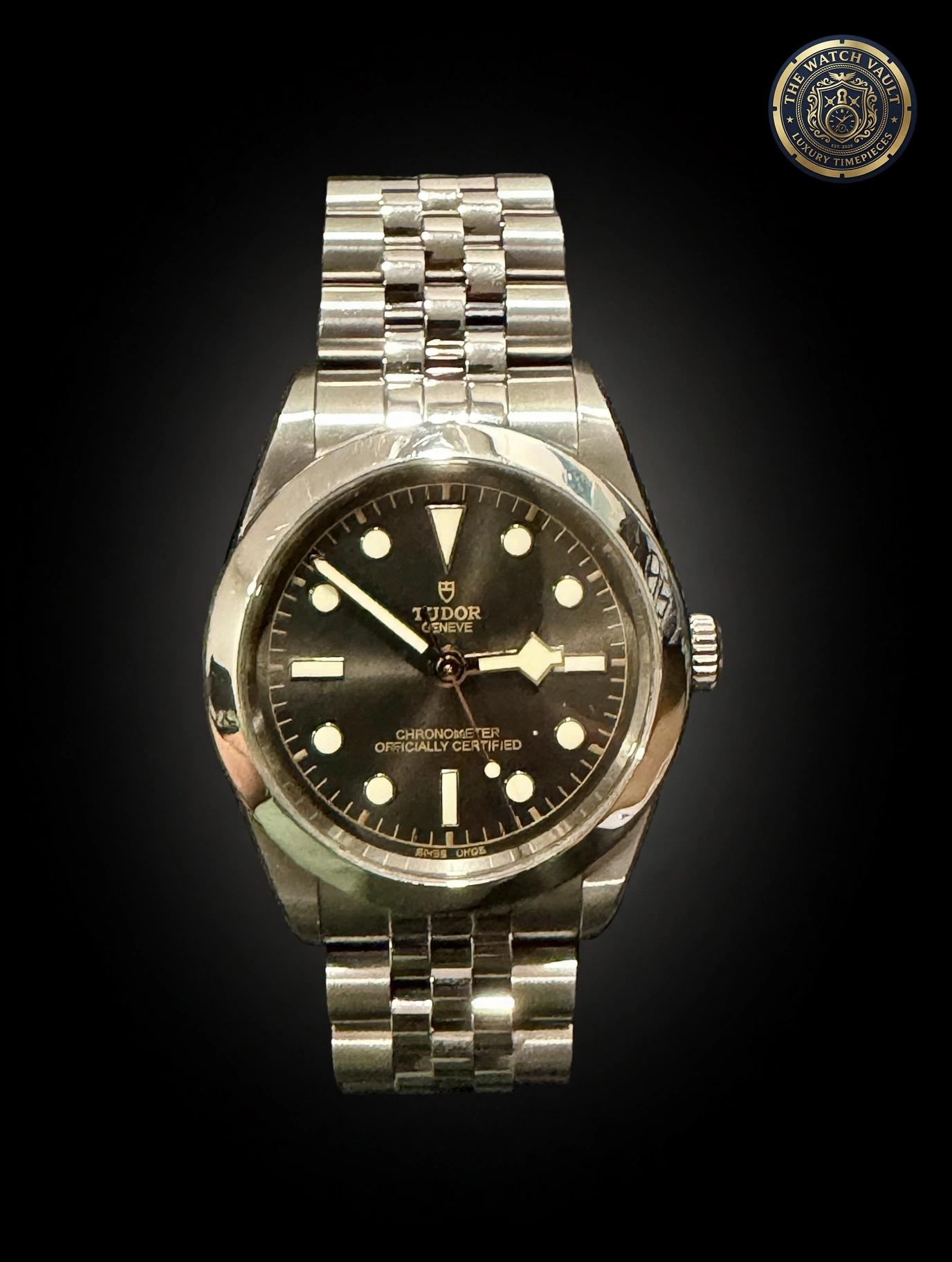
Our 2024 Tudor Black Bay 39 came in as a full set: box, papers, hang tags — and separately, an independent authentication report from Bennison. The papers help tell the watch's history; the report provides an additional layer of confidence about the watch itself. Different jobs.
Our 2013 Rolex Explorer came with its papers and warranty card, but no box. So it's watch with papers — not naked, and we don't describe it as naked. Same inspection process on both. The missing box doesn't change the watch itself. It may change what a buyer is willing to pay for it, though. Apparently, cardboard can get pretty expensive when there's a Rolex involved.
When the extras may not be worth paying for
If you're buying a watch to wear — actually wear, every day — the box will live in your closet. A watch-only example can give you the exact same experience on your wrist without paying extra for a box that's going to spend the next decade collecting dust in your closet. That's not a compromise. That's a smart buy.
The one thing to check either way
Serial numbers. When the documentation includes a watch serial number — as modern warranty cards do — it should match the serial on the watch. A card that doesn't match the watch is decoration, not documentation. It could be an innocent mix-up, or it could be something more concerning. Either way, it's worth asking questions before handing over your money. And even a card that does match doesn't independently prove authenticity — it's supporting evidence, not the verdict. (On some older watches, original papers may not display a serial number the same way, so this check applies where a serial is actually present.) We verify serial numbers on every watch where they're accessible without opening the case. When a watch comes with serial-numbered documentation, we check that the numbers match.
The short version
If you're collecting, the extras may be worth paying for. If you're buying something to wear every day, they may not be. Neither approach is wrong. Just make sure you know what you're paying for.
Browse the vault at watchvaultok.com — and if you're thinking about selling, the box and papers help there too. Bring them if you've got them.